
- Knowledge Base Categories:
- School Accounting System
- Payroll
Training Tidbit: How can I provide employees their total qualified overtime compensation for 2025?
With the guidance recently issued by the IRS regarding reporting overtime under the OBBBA (One Big Beautiful Bill Act), the IRS is providing employers penalty relief for tax year 2025, and encourages employers to provide the amounts (or approximate amounts as part of the transitional relief for employers) designated as qualified overtime compensation to employees for 2025.
As a reminder, with the OBBBA, employees with qualified overtime compensation are able to deduct the amount of pay exceeding their regular rate of pay (deduct the “half” of the time and a half rate) when filing their individual tax return. This is applicable only for overtime paid after 40 hours in a week.
Since the W2 forms for tax year 2025 did not change (other than verbiage on the back was updated for the new year), and the new boxes for reporting cash tips, qualified overtime compensation, and employer contributions to Trump accounts will be included on the 2026 W2s, there is a new report included in the School Accounting System that can be used to provide the approximate amounts of qualified overtime compensation to employees for 2025. The new report is called Estimated Qualified Overtime Compensation Report (see example below) and is available in Payroll under the Reports menu and Other Reports. The report can be utilized if overtime is defined as a separate pay code within Payroll for the full rate of time and a half, and overtime is calculated after 40 hours per week. When printing the Estimated Qualified Overtime Compensation Report, only overtime pay codes will be included, and then be sure to select all check dates in 2025. (Tip: After selecting the check dates for 2025, change the Processing Month parameter to select all months.)
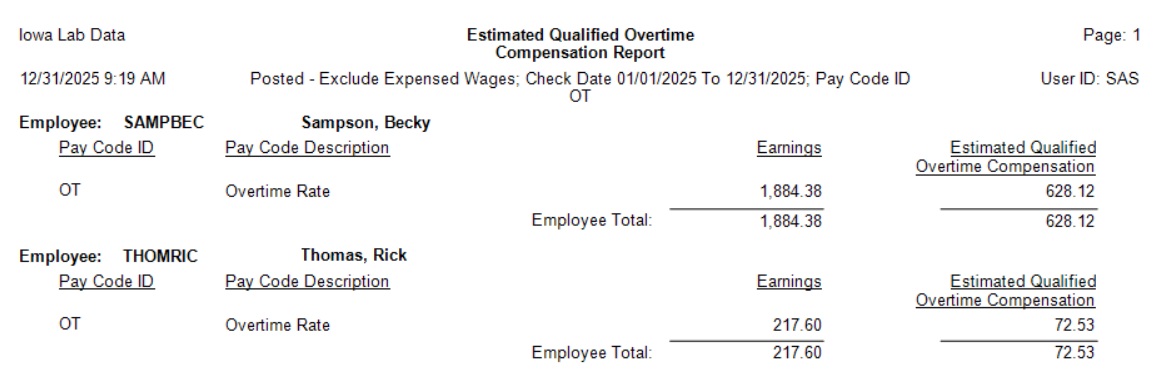
The Estimated Qualified Overtime Compensation Report prints the employees who were paid overtime (based on the overtime pay codes selected when generating the report), along with the total amount paid for overtime and the approximate total amount of qualified overtime compensation. The Earnings column shows the total gross amount paid to the employee for the specified overtime pay code (the full rate of time and a half), and the Estimated Qualified Overtime Compensation column reflects one third of the Earnings column for the “half” of the time and a half compensation paid to the employee.
Important: If your overtime pay code is defined only with the “half” of the time and a half rate rather than the full rate of time and a half (i.e. the overtime pay code is defined with a rate of $5 instead of the full $15 overtime rate), the amount in the Earnings column on the Estimated Qualified Overtime Compensation Report would reflect the amount of qualified overtime compensation for the employee instead (and the Estimated Qualified Overtime Compensation column would not be applicable). Also, if a blended overtime rate is used, all the above information would still be applicable based on whether the blended overtime pay code is defined with the full overtime rate (the time and a half rate) or just the “half” of the time and a half rate.
Note: The recent guidance from the IRS states that the qualified overtime compensation can be made available to employees by written statements provided to employees, an online portal, or including the amount in Box 14 on the W2 form. Keep in mind, with the School Accounting System, the amount of qualified overtime compensation will not be able to be posted to the 2025 W2s (will be able to be posted to the correct box in 2026), and so utilize the Estimated Qualified Overtime Compensation Report by printing and distributing the report with the W2s, emailing the report to the employees, or making the report available within the Web Link module for the employees to print. For more information on the recent guidance from the IRS for reporting on overtime, click here, and for examples on determining the amount of qualified overtime compensation with different overtime scenarios, including double time and compensatory time, click here.